Intro
Hijama therapy is often described as a way to “remove toxins,” but this explanation can be misleading. Many people seek Hijama therapy expecting a detox effect, especially when dealing with pain, fatigue, or a heavy, tight feeling in the body. The real question is not whether Hijama therapy removes toxins, but what is actually happening in the tissues during treatment—and why that matters for recovery.
What Type of Problem Is This?
This is primarily a circulatory and lymphatic congestion issue, not a toxin problem in the traditional sense. When tissues become overloaded—whether from prolonged posture, repetitive strain, or incomplete recovery—they can develop local stagnation, where blood flow slows and inflammatory byproducts accumulate.
Instead of thinking “toxins,” it is more accurate to understand this as poor fluid exchange at a local tissue level. When circulation and lymphatic drainage are not moving efficiently, the area can feel tight, swollen, or heavy. This is often why people describe relief after Hijama—not because toxins are removed, but because the local environment improves.
Why Does This Keep Coming Back?
The reason this type of issue persists is that the body does not always fully clear local congestion on its own. Areas under repeated stress—such as the upper back, neck, or lower back—can develop chronic low-level stagnation.
Over time, this creates a cycle where:
- Circulation becomes less efficient
- Waste byproducts linger longer
- Tissue sensitivity increases
- Movement feels restricted or uncomfortable
The key insight is that the body is not “toxic”—it is simply not clearing certain areas efficiently. If the underlying stress or load remains, the congestion tends to return.
How Do We Approach Hijama Therapy?
Identify the driver:
Assessment focuses on identifying where congestion is actually present, rather than applying Hijama randomly. This includes palpation for tissue density, temperature changes, and sensitivity, along with observing how different areas respond to pressure and movement. Not every painful area is congested—and not every congested area is the main driver.
Treat the source:
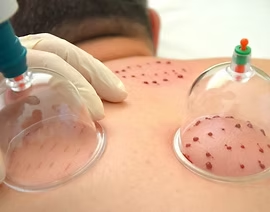
Hijama therapy is then applied in a controlled and targeted way. The initial suction draws circulation to the surface, followed by very superficial micro-incisions and a second suction phase to remove a small amount of capillary-level fluid. This process helps reduce local stagnation and improves microcirculation without penetrating deeper tissues. :contentReference[oaicite:0]{index=0}
Restore movement:
As the local tissue environment improves, people often notice reduced heaviness and easier movement. The goal is not just temporary relief, but allowing the area to function more normally again by improving how fluids move through it.
What Makes This Case Different?
Not all pain or tightness is related to congestion. Some cases are driven by joint restriction, nerve sensitivity, or deeper muscular dysfunction. Hijama therapy is most effective when the primary issue is local stagnation—not when the problem lies elsewhere.
This is why two people with similar symptoms may respond very differently to the same treatment.
What Can You Do?
- Avoid prolonged static positions that reduce circulation
- Stay hydrated to support normal fluid movement
- Use regular movement to assist lymphatic flow
- Seek assessment if areas feel persistently heavy or “stuck”
Conclusion
Hijama therapy does not “remove toxins” in the way it is often described. Its real value lies in improving local circulation and reducing tissue congestion, which can help relieve pain and restore movement when used appropriately. If you are dealing with persistent tightness or heaviness that does not respond to other approaches, a proper assessment can determine whether Hijama therapy is the right fit for your case.
References
- Almutairi R, et al. Evaluation of the Effectiveness of Wet Cupping Therapy in Patients with Fibromyalgia. Complementary Medicine Research. 2024.
- Abadi F, et al. The Impact of Wet Cupping on Haematological and Immunological Parameters in Athletes. Journal of Clinical Medicine Research. 2024.
- Siregar R, et al. A Model to Standardize Safety and Quality of Care for Cupping Therapy. Journal of Integrative Medicine. 2021.