Intro
Hijama vs dry cupping is one of the most common questions people ask when considering treatment. Both use suction, both leave marks, and both are often grouped together—but clinically, they are used for very different reasons. Understanding the difference is important, because choosing the wrong approach can mean treating the symptom instead of the actual problem.
What Type of Problem Is This?
This comparison comes down to circulatory vs superficial tissue response. Both Hijama (wet cupping) and dry cupping influence blood flow and soft tissue, but they act at slightly different levels.
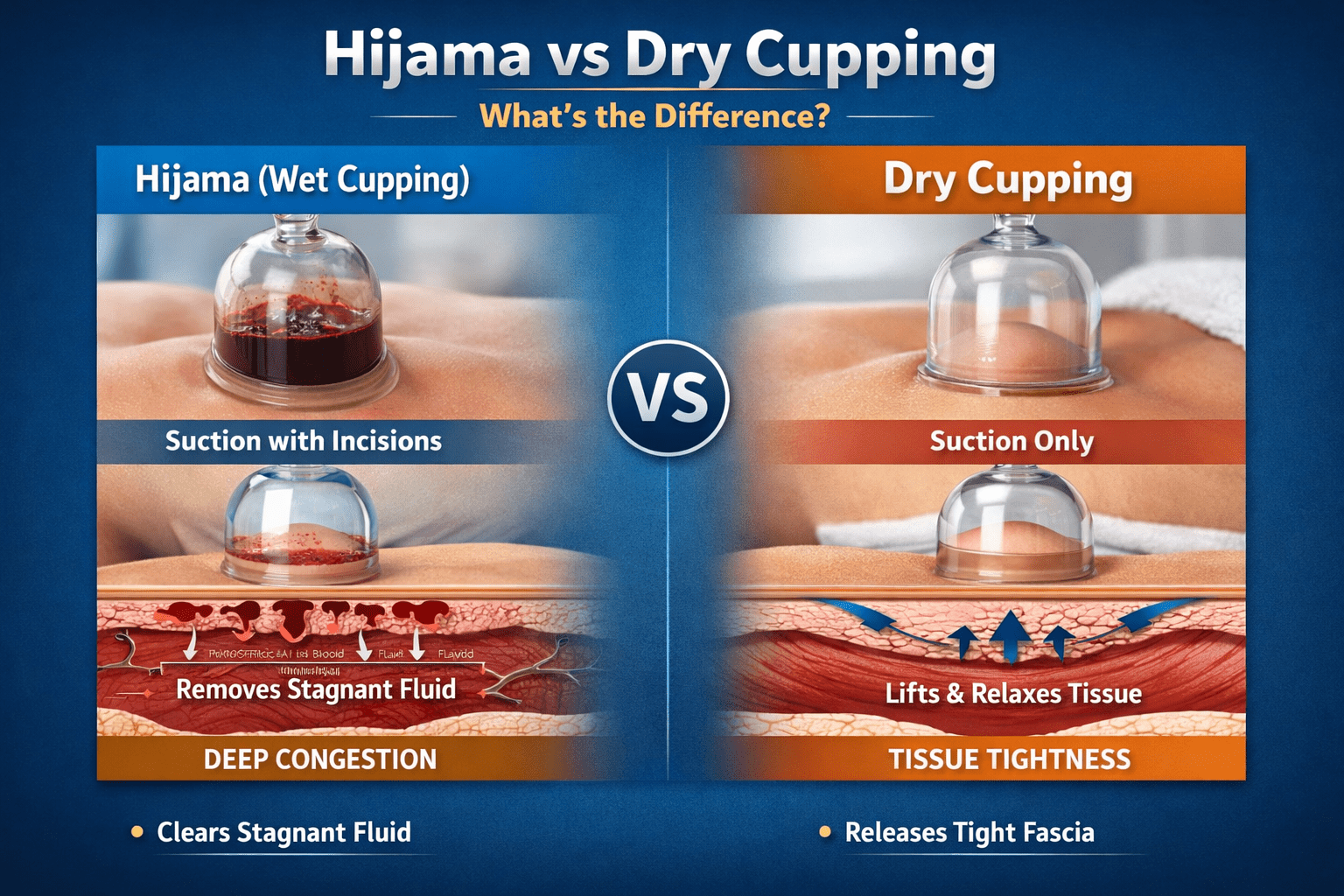
Dry cupping primarily creates a mechanical lifting effect on the skin and superficial fascia. This changes pressure in the area, improves blood flow temporarily, and can reduce tightness in surface-level tissues.
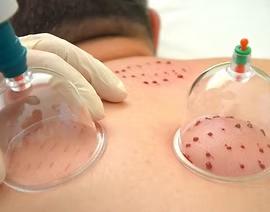
Hijama therapy, on the other hand, is used when there is deeper local congestion—where fluid exchange is not clearing efficiently and the tissue feels heavy, dense, or inflamed. By adding a second phase with very superficial micro-incisions, Hijama allows a small amount of capillary-level fluid to be drawn out, targeting that stagnation more directly. :contentReference[oaicite:0]{index=0}
The key difference is this: dry cupping influences movement of fluid, while Hijama is used when that fluid is not clearing properly.
Why Does This Keep Coming Back?
Many people try cupping and get temporary relief, only for the tightness or discomfort to return. This usually happens when the type of cupping does not match the underlying driver.
If the issue is mainly surface-level restriction or muscle tightness, dry cupping may help briefly but not address deeper congestion. If the issue is persistent stagnation, dry cupping alone may not be enough to change the local tissue environment.
Over time, this creates a pattern where:
- The same areas feel tight again
- Relief becomes shorter-lived
- The tissue starts to feel dense or “stuck”
The important insight is that recurrence is often not about the technique failing, but about the wrong technique being used for that specific presentation.
How Do We Approach Hijama vs Dry Cupping?
Identify the driver:
Assessment determines whether the problem is superficial restriction or deeper congestion. This involves palpation for tissue density, sensitivity, and how the area responds to pressure and movement. Areas that feel soft but tight often respond differently compared to areas that feel thick, heavy, or inflamed. This distinction guides the entire treatment decision.
Treat the source:
If the presentation is superficial, dry cupping may be used to lift and decompress the tissue. If there are clear signs of stagnation, Hijama therapy is applied in a targeted way. This includes an initial suction phase, followed by controlled, superficial micro-incisions and a second suction stage to reduce local congestion. This is not a stronger version of cupping—it is a different tool for a different problem.
Restore movement:
Once the appropriate method is used, the tissue typically becomes less restricted and movement feels easier. The goal is not just to create marks or short-term relief, but to change how the area functions and recovers over time.
What Makes This Case Different?
Two people can have the same pain location but need completely different approaches. One may respond well to dry cupping because their issue is surface-level tightness. Another may only improve when Hijama is used because the problem is deeper congestion.
This is why cupping should never be applied as a routine or standard protocol—its effectiveness depends entirely on matching the technique to the underlying tissue behaviour.
What Can You Do?
- Pay attention to how long relief lasts after treatment
- Avoid assuming all cupping methods do the same thing
- Seek assessment rather than choosing a technique based on preference
- Address contributing factors like posture and repetitive load
Conclusion
Hijama vs dry cupping is not about which one is better—it is about which one is appropriate for your condition. Dry cupping is useful for surface-level restriction, while Hijama therapy is more suited to deeper tissue congestion. The real difference in results comes from accurate assessment and targeted application, not the technique alone. If your symptoms keep returning, it may be time to reassess what is actually driving the problem and choose the approach that matches it.
References
- Almutairi R, et al. Evaluation of the Effectiveness of Wet Cupping Therapy in Patients with Fibromyalgia. Complementary Medicine Research. 2024.
- Abadi F, et al. The Impact of Wet Cupping on Haematological and Immunological Parameters in Athletes. Journal of Clinical Medicine Research. 2024.
- Siregar R, et al. A Model to Standardize Safety and Quality of Care for Cupping Therapy. Journal of Integrative Medicine. 2021.